The Fine Print
The United States declared independence in 1776, but this current government under the U.S. Constitution wasn't established until 1789. Some historians distinguish between the founding of the nation (1776) and the beginning of the unified, constitutional republic (1789). For most, the 1776 date is the one that is observed (at this time) simply because our (inter)national identity started with declaring our independence, so the official timer started on July 4, 1776, making July 4, 2026, the country's (un)official 250th milestone; if it is still viewed upon as such, then so be it. I mean what can one do?.... Argue with the bullies of the world? Ha! This Fine Print article exposes yet more swept-under-the-rug facts that many willfully turn a blind eye to.....
BBBPOLITICSAMERICANPATRIOTICHISTORYCOUNTRY LIFEEDUCATIONPIONEERSTRADITIONAL VALUES
Once Generation X is gone, the last living bridge to the twentieth century goes with it. What remains won’t be memory—it’ll be records, reports, and secondhand accounts trying to explain a world people no longer experienced firsthand. And in a country that prides itself on freedom—loudly, constantly—that gap between what’s remembered and what’s real starts to matter more than we care to admit.
Nobody really explains the quiet side of it…the part that doesn’t come with a speech or a flag slapped on it. The parts you only learn by being here long enough to feel it; because there’s an unspoken protocol to being American—how you carry yourself, how you work, how you mind your business, how you don’t. And lately, in places far from headlines and cameras—waiting in line, standing around, passing time—you can hear something else creeping into conversations. A question forming under the surface: not just what does it mean to be here, but how can you know who's really American anymore?
That question doesn’t come out of nowhere—it grows from the gap between what America says it is and how it actually operates day to day. Because the truth is, nobody hands you a rulebook when you get here. You learn it in fragments: in how people expect you to speak, how quickly you’re supposed to get on your feet, how much independence is assumed of you whether you’re ready or not. You learn that being “American” isn’t just a legal status—it’s a pattern of behavior you either fall into or push against. And when that rhythm starts to feel less consistent, that’s when uncertainty creeps in. Not always rationally, but enough to make people start looking a little closer, trying to figure out what used to be obvious.
In some places, that uncertainty is already showing—not as open confrontation, but it's giving... scrutiny.
You hear it in passing conversations, in the way people size each other up without saying much at all. And, no, for many, it doesn’t come from 'bigotry and fascism' so much as an instinct—the same instinct that makes someone protect their home, and families. The line gets blurry there. Because wanting stability, safety, and a sense of order in your own life doesn’t come with a clear rulebook for where caution ends and assumption begins. And in that gray space, people start creating their own quiet ways of deciding who feels familiar, who feels out of place, and what that even means anymore.
This is where the conversation gets tangled—because behind all the frustration there are real numbers and real patterns that deserve to be looked at clearly, not just emotionally. Immigration to the United States isn’t coming from one place or one type of person; it’s layered, shifting, and driven by economic forces, opportunities, and policy gaps that most everyday Americans never fully see. Money moves across borders, labor fills gaps in industries, and systems—both legal and gray—get used in ways that feel invisible until you’re standing close enough to notice them.
For people already struggling to stay afloat, that connection can feel like something is being overlooked half the time and unevenly enforced the other half. The muted question then becomes: HOW THE HECK CAN WE INSTITUTE LAWS THAT (IN SOME ROUNDABOUT WAY) ALLOW FOR THESE LOOPHOLES TO CONTINUE?! This stance is not one made out of ignorant speculation, but rather one from extensive research paired with firsthand in-person experienceS - plural.
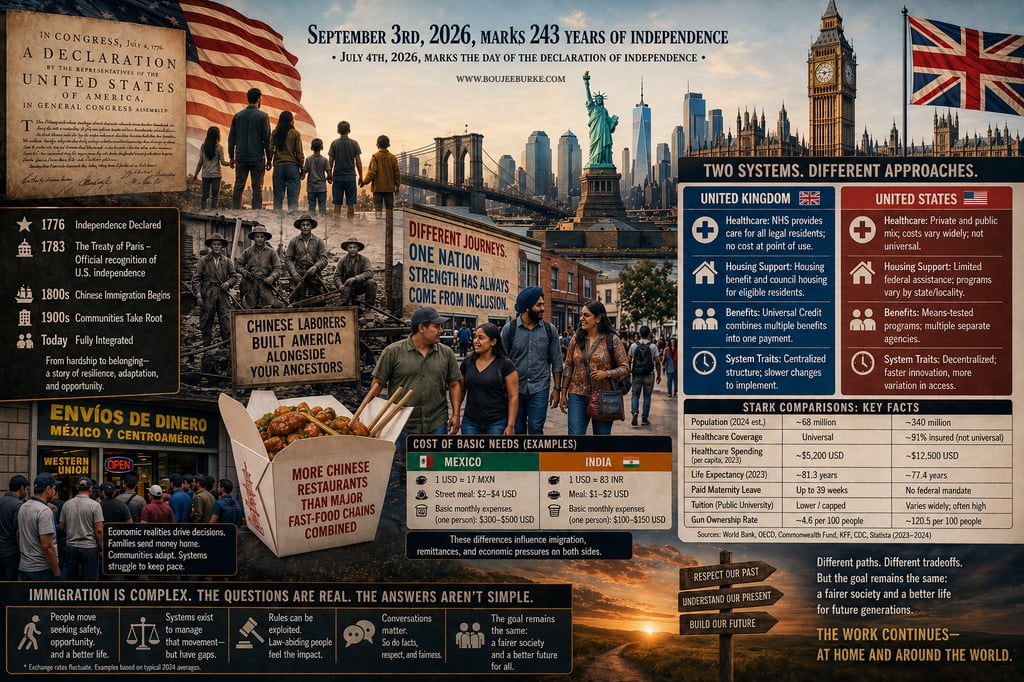
In truth, hurt feelings aside, I've seen it with my own two eyes, several times over, up close and personal. See, in Mexico, a dollar of ours is worth 17 of theirs. And, the order is as follows:
THEY LINE UP AT CHECK-CASHING LOCATIONS AND SEND TAX-FREE, MONEY PAID UNDER THE TABLE BACK HOME TO MEXICO....IN THE HUNDREDS VIA WESTERN UNION. (During this process, many opt to live together in small, fire hazard groups within apartment dwellings all throughout the 5 NYC boroughs.) I know these instances exclusively, as I worked as a teller for a check-cashing location in southwest Brooklyn, I also had several Mexican friends while I was growing up. Like I said: I said 'exclusively'.
*Another verifiable instance would be to spotlight the legal flip-flop surrounding Indian migration. Did you know, for one American dollar, you can buy a whole meal in India... get a haircut and shit. And for a hundred ($100), you could cover basic living expenses for like a month! Now, in case you have been living in a hole, the hustle goes like this: they continue to come here, investing in hotels and motels, firing whole staffs and replacing them with their own family members. And while residing within the hotel, they can accumulate enough money to keep this going. Lo and behold, Indians now own about 80% of the hotel industry in America. Many of which also take full advantage of the 183 Day Rule. And, this circle-jerk is legal, of course. As it seems, tax breaks aren't only for the rich.
*Yes, I've worked at a few hotels and resorts too. Moving right along. . .
Going by publicly available U.S. immigration data, the foreign-born population in the United States is large and diverse, with no single country accounting for a majority. As of recent estimates, Mexico remains the largest country of origin, making up roughly 23–25% of the total immigrant population. India is among the top countries of origin as well, though at a much smaller share, generally around 6–7%. Other significant countries include China, the Philippines, and El Salvador. For instance, it is believed that Honduras and Guatemalan migrants, under the Biden administration, were emigrating to the United States because conditions in their countries were unbearable with regards to food and agriculture yet the constant rising cost of food and produce on this end is continuously rising so if someone can help rationalize this supposed logic that would be great until then I along with many other Americans will hold the same sentiment.
Economic behavior within immigrant communities also reflects broader global realities. Many immigrants send money abroad—known as remittances—which contribute significantly to the economies of their home countries. This practice is legal and common worldwide among legal residents, not unique to the United States. But one must heed to the words "legal residents". And if that sounds abstract, don’t worry—it gets much more visible once you begin to pay attention.
If you were to look at a separate set of numbers, the scale of Chinese cuisine in America goes far beyond casual observation. Depending on how it’s measured, estimates range from roughly 25,000 formally classified Chinese restaurant businesses to as many as 80,000–90,000 establishments when including takeout spots and hybrid menus. Within the broader restaurant landscape, Asian cuisine makes up about 12% of all U.S. restaurants, and Chinese food dominates that category—accounting for nearly 40% of Asian establishments and appearing in roughly 70% of U.S. counties. Some analyses even point out that Chinese restaurants collectively outnumber major fast-food chains combined, underscoring just how deeply embedded they are in everyday American life. What that reflects isn’t just preference—it’s decades of migration, adaptation, and economic foothold that have made Chinese food one of the most widespread and normalized dining options in the country. That, and it's delicious, too.
And while that may seem like a small, almost casual detail, it points to something much bigger. Zooming out from consumption to protocol structures, 243 years after the colonies won independence and solidified it with the Treaty of Paris, the outcome is clear in this sense: the United States is independent to an extent. Beyond that, the results are less about celebration and more about a parallel analogy.
In many aspects, the United States and the United Kingdom are like night and day; the UK operates with a centralized structure—unified benefits, housing support built into assistance, and healthcare through the National Health Service that removes cost at the point of use. The tradeoff is slower movement and tighter budgets. Whereas the United States operates differently, with fragmented systems, higher costs, and wider variance in outcomes depending on income, location, and access. The tradeoff here is: range. Both systems function as designed. Neither eliminates tradeoffs.
And then there’s the part that doesn’t need interpretation—just observation. A country built on independence now runs on global integration: foreign-made vehicles on the road, foreign-manufactured devices in hand, and clothing produced overseas - all of this has become the norm. Independence established separation from rule. It did not establish isolation from reliance.
Can you imagine just how our politicians and media outlets will repackage this come 2039?!


TAG A FRIEND THAT NEEDS TO READ THIS