OFF-THE-GRID URBAN RESIDENCY: THE TRANSITIONAL EXIT STRATEGY
AMERICANCOUNTRY LIFEAMERICAN NATURAL RESOURCESWELLNESSOFF THE GRIDBBB
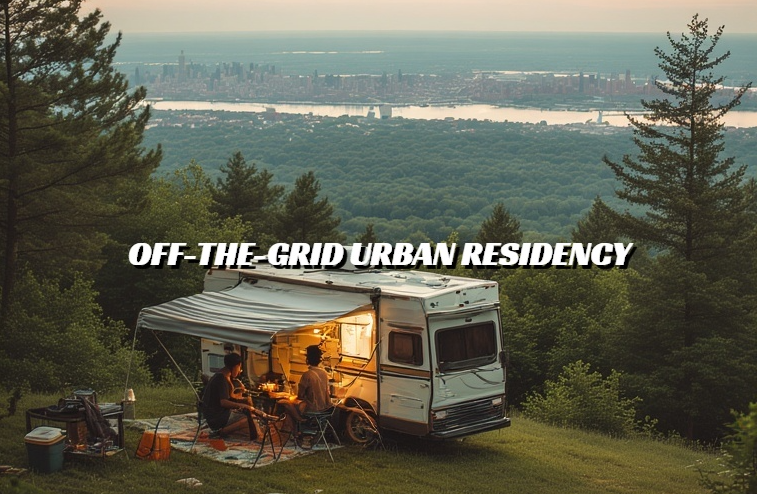

Ok, let’s get one thing straight before anyone wastes time, money, or credibility. Most people cannot realistically transform apartment buildings, tenements, or tightly regulated residential structures into fully off-grid fortresses. That idea belongs to YouTube thumbnails and daydreams. This article is not about retrofitting high-rises or illegally severing municipal hookups.
This is about transition.
Off-the-grid urban residency is the bridge between conventional housing and true independence. It is the deliberate shift from apartments and houses into mobile or semi-mobile dwellings such as RVs, campers, converted vans, cabins, tree houses, tents, and hybrid shelters, while still operating within or on the edge of urban and peri-urban environments. You do not jump from a lease to the wilderness overnight. You phase out dependency while maintaining proximity to resources, knowledge, and community.
WHAT OFF-GRID MEANS IN PRACTICE, NOT THEORY
In cities and metro-adjacent zones, off-grid living is not absolute disconnection. It is controlled disengagement. The goal is to reduce reliance on public utilities and centralized systems while building autonomous replacements that can travel with you or be redeployed elsewhere.
This is why transitional dwellings matter.
RVs, campers, vans, temporary cabins, tents, and tree-supported shelters are not loopholes. They are strategic tools. They allow you to live independently without violating building codes designed for permanent structures. They are flexible, movable, and far more adaptable to zoning realities than fixed residences. Urban off-grid living is not about isolation. It is about mobility, redundancy, and learning how to sustain yourself without the illusion of permanence.
WHERE KNOWLEDGE COMES FROM
All city water, sewage, and zoning regulations are local ordinances embedded in municipal code. These are public records. They can be accessed at public libraries, city halls, or online databases. Libraries remain one of the most reliable fallback resources available. No cellphone. No WiFi. No subscription. Still operational.
If you cannot be bothered to read local code, you are not serious about off-grid living. Period.
HOW TRANSITIONAL OFF-GRID LIVING WORKS
Integrate. Completely cutting yourself off from society is foolish at this stage. You need reference points. You need observation. You need to learn from others who are already doing this successfully. Seek out nearby communities, informal settlements, RV clusters, land-share arrangements, and semi-rural edges of cities. Introduce yourself. Observe how people manage water, waste, security, and legality in real time.
Secure a settlement zone. This is not about ownership. It is about positioning. Look for locations that are far enough from dense enforcement zones but close enough to essential services. Industrial fringes, agricultural buffers, desert edges, forest margins, and overlooked parcels near cities are where transitional living actually works. Visibility to other like-minded individuals matters more than solitude.
Energy independence. Portable solar systems paired with battery storage are the backbone of transitional off-grid living. Roof-mounted panels on RVs, ground-deployed arrays near tents or cabins, and modular battery units provide electricity without permanent infrastructure. This insulates you from blackouts and utility dependency while remaining mobile.
Water solutions. Rainwater harvesting, water hauling, filtration systems, and storage tanks are standard in transitional dwellings. Barrels, collapsible containers, and gravity-fed filters allow you to operate independently while complying with local restrictions. The key is redundancy. Never rely on a single water source.
WASTE MANAGEMENT:
This is where discipline separates adults from hobbyists. Off-grid waste management is about radical reduction first. Composting, recycling, reusing, and minimizing inputs are non-negotiable.
Human waste is handled through composting toilets, humanure systems, portable cassette toilets, or serviced outhouses, depending on legality and location. Greywater from sinks and showers can be filtered and reused for irrigation when biodegradable soaps are used and kitchens and toilets are excluded. Non-compostable trash is transported periodically to transfer stations or landfills.
The philosophy is reduce, reuse, compost. Trash is not something you “throw away.” It is something you manage deliberately.
GREYWATER AND HUMAN WASTE, CLEARLY DEFINED
Greywater is used household water from sinks, showers, tubs, and laundry that can be redirected for non-potable uses such as irrigation. When handled correctly, it reduces water consumption and waste output while supporting basic sanitation. This only works with biodegradable soaps and strict separation from toilets and kitchen waste.
Composting toilets collect solid waste and use materials like sawdust or ash to facilitate decomposition into stable compost. Urine is typically diverted into soakaways or containers. A urine soakaway is a simple underground pit or system that safely disperses liquid human waste (urine) into the soil, acting as a natural filter, often used with urine-diverting toilets to keep solids and liquids separate, preventing compost saturation and odors, and managing waste efficiently without plumbing. It's a pit filled with gravel and lined with membrane that allows urine to percolate into the earth, ideal for managing high volumes of liquid from parties or frequent use These systems are common in RVs, cabins, and temporary shelters and are often the most legally viable option in transitional settings.
Outhouses, where permitted, are managed with ash or sawdust and serviced periodically by septic services if required.
THE INCREMENTAL PATH, NOT THE LEAP
No one becomes off-grid by declaration. You start with one system and build outward. Energy first. Then water. Then waste reduction. Each system lowers your dependency and sharpens your competence.
Transitional living allows mistakes without catastrophic consequences. That is the point.
THE REAL SHIFT IS INTERNAL
Yes, inner-city people can absolutely abandon ship and move into this lifestyle. But understand this clearly: it takes at least a year to truly grasp how to live this way without constant friction. The most important adaptation is psychological. When you fully decide to leave the rat race, the work becomes satisfying. Establishing a settlement, however temporary, becomes meaningful. If you are unsure, stop now. You will waste resources and everyone’s time. Fantasies do not survive exposure to reality.
This path is for people who are committed, disciplined, and willing to learn. For those who are serious, start up with a step-by-step blueprint, like this one. Study local codes, and build systems that move with you. Visit our "Categories' drop menu above to deepen your knowledge and access imperative resources.
Sources: ShopSolar, EcoFlow, Separett.shop.