Self-Sufficiency & the Modernized American Woman
Women have been rewritten as decorative when history proves we are survivors. Meet the conservation leaders and modern bushcraft women who embody real resilience, competence, and power.
OFF-THE-GRIDAMERICANSURVIVAL BBB
How did today’s girls, ladies, and grown women end up knowing every Kardashian contour trick but none of the women who literally fought to protect the land beneath their feet?
Somewhere along the line, rugged survival knowledge was replaced with influencer fluff. Meanwhile, some of the most formidable women in American history are barely mentioned, despite shaping conservation, wilderness protection, and environmental ethics that still keep this country standing.
Take Margaret “Mardy” Murie, known as the Grandmother of the Wilderness. She was instrumental in protecting millions of acres of Alaskan land and helping pass the Wilderness Act. Rachel Carson, a marine biologist, author, and absolute force, shook the world with Silent Spring and launched the modern environmental movement by daring to challenge chemical corporations poisoning the planet. Celia Hunter helped found The Wilderness Society and fought relentlessly to protect public lands for future generations. These women weren’t “soft.” They were strategic, educated, resilient, and unmovable.
And this legacy didn’t stop in the past.
Modern women are still out there doing the work, surviving, teaching, and leading without begging for attention. Megan Hine runs extreme expeditions, teaches survival under brutal conditions, and consults on high-risk television productions. Alli of Lustaufbergvsbushcraft brings professionalism, hunting, archery, and bushcraft into the modern age with precision and grit. Patricia Klidis combines mountaineering, gear knowledge, and a deep respect for nature. Alexis Outdoors brings a fresh, unapologetic bushcraft approach that proves competence doesn’t need theatrics. Bush Eule captures raw wilderness living through fishing, survival, and genuine connection to the land.
These women represent something deeply unfashionable today: capability.
And here’s the part no one likes to talk about. Women, statistically, tend to fare better in survival situations than men. Search-and-rescue data shows men initiate most rescues, yet a higher percentage of them die compared to women. That’s not luck. That’s decision-making. Women are more likely to pause, conserve energy, assess risk, and avoid ego-driven mistakes.
Biologically, women often have higher body fat percentages that provide insulation and energy reserves in cold or food-scarce environments. Female metabolism is generally more efficient at burning fat during prolonged exertion, preserving critical glycogen stores. Estrogen plays a role in immune response and blood flow regulation, contributing to resilience under stress. Even historically, newborn girls have shown higher survival rates than boys during famines and epidemics.
This isn’t weakness. This is adaptation.
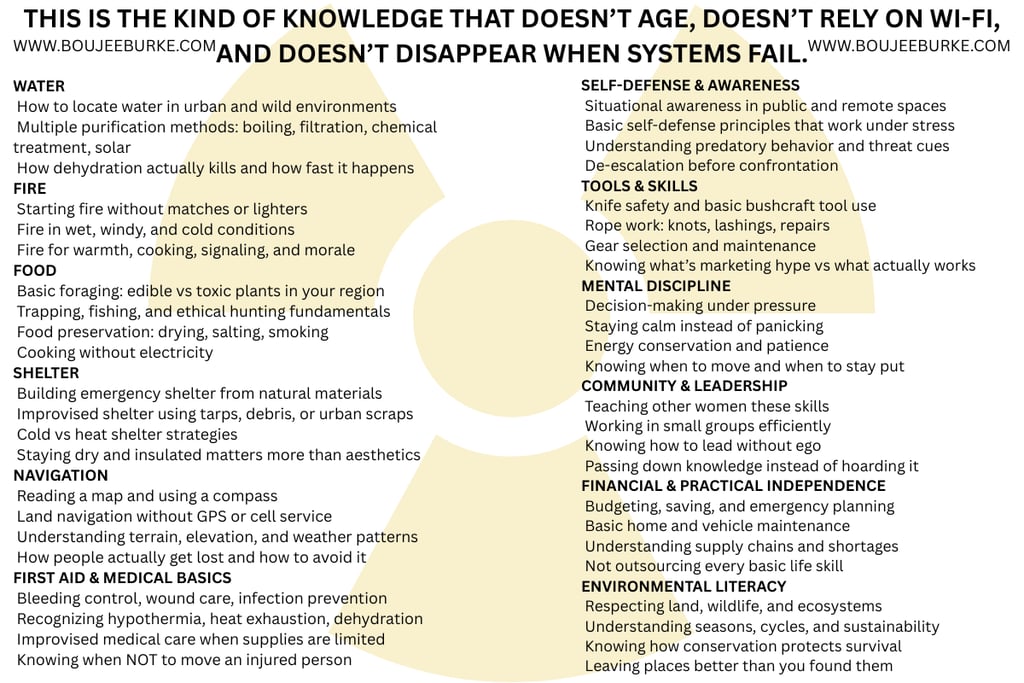
So when society pushes shallow ideals and trains women to obsess over appearances instead of competence, it’s not just embarrassing, it’s dangerous. There are real women, blue-collar women, dirt-under-the-nails women, who know how to build fire, find water, read terrain, and survive when things go sideways.
If you’re going to idolize someone, make it the women who can keep themselves alive when comfort disappears. Because lashes don’t keep you warm. Filters don’t purify water. And validation won’t save you when the lights go out.