WHY Doesn't every American Know This?!
A plain-English, Laymans term breakdown of the U.S. Constitution, the Bill of Rights, and why America is a constitutional republic, not a pure democracy. America had founding fathers, not a founding father. Learn of the exact laws that protects our rights, and how Andrew Jackson reshaped popular politics.
THE CONSTITUTIONBILL OF RIGHTSREAL DEMOCRACYAMERICAN REPUBLICAMERICANBBB
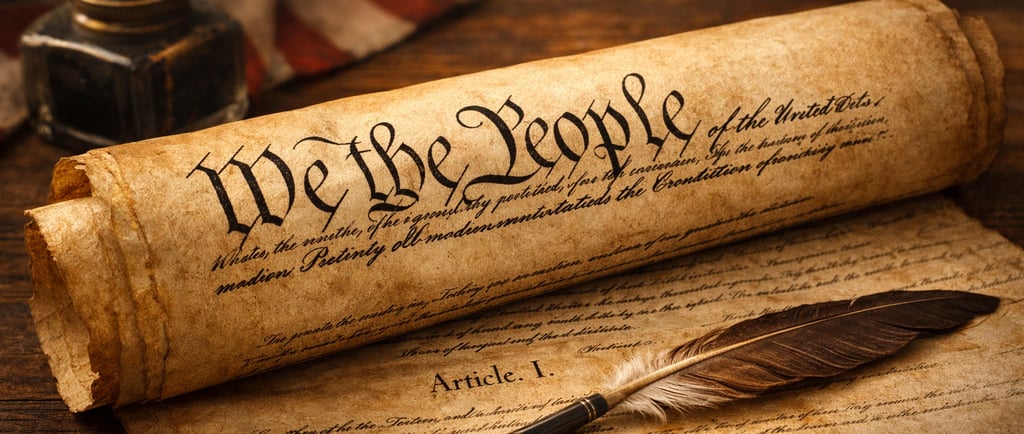
The United States Constitution is America’s rulebook. It is not a vague idea or a feel-good document. It is a structured plan for how power is created, limited, and controlled. Written in 1787 and ratified in 1788, the Constitution established a government designed to serve the people while preventing any single individual, branch, or faction from becoming too powerful.
At its core, the Constitution creates three separate branches of government, divides authority between federal and state levels, and guarantees a baseline set of individual rights. Those rights are not suggestions. They are written into the document itself.
Yes, the Bill of Rights is part of the U.S. Constitution. The first ten amendments are not a separate document, an afterthought, or optional add-ons. They are embedded within the Constitution and legally binding. Surprisingly, many people are never taught that. In simple terms, the Constitution is a plan for “We the People” to govern ourselves. It establishes limits on government power, ensures accountability, and protects the liberties of lawful citizens. But bear in mind: what was once accepted as pure democratic theory has evolved into disingenuous stunts.
In a nutshell: the legitimate, righteous purpose behind the creation of the Democratic Party has been abandoned. What remains is self-righteous theater, pocket-lining alliances with global banks and big business, and the animated, radicalized antics of a swamp-fed political class that bamboozles the public, misuses power, and openly neglects its own citizens. Those same citizens, conditioned since childhood, now stand complicit in the mess. Below is a little crash-course that will be of use to those that need to know:
The Preamble
The opening paragraph sets the tone and purpose of the entire document. It states that the Constitution exists to establish justice, ensure domestic tranquility, provide for the common defense, promote general welfare, and secure the blessings of liberty for both current and future generations. This is the mission statement of the United States.
Separation of Powers: The Three Branches
Legislative Branch, Congress
Congress makes the laws. It is divided into two chambers: the House of Representatives and the Senate. This branch controls legislation, taxation, and declarations of war.
Executive Branch, the President
The President enforces the laws passed by Congress, serves as Commander in Chief of the armed forces, and manages the federal government.
Judicial Branch, the Courts
The courts interpret the law. The Supreme Court sits at the top and has the final authority on constitutional interpretation.
Checks and Balances
Each branch has the ability to limit the others. The President can veto laws, Congress can override vetoes, and courts can declare laws unconstitutional. This system exists specifically to prevent tyranny.
Federalism
Power is shared between the national government and individual states. States are not subsidiaries of Washington. They retain authority over many areas of law and governance.
Amendments
The Constitution can be changed, but only through a difficult and deliberate process. The first ten amendments are known as the Bill of Rights.
The Bill of Rights Explained in Plain English
First Amendment
Protects freedom of religion, speech, press, assembly, and the right to petition the government. You are allowed to speak freely, worship or not worship, criticize the government, and gather peacefully.
Second Amendment
Protects the right of the people to keep and bear arms. This was written to ensure citizens could defend themselves and resist tyranny.
Third Amendment
Prevents the government from forcing citizens to house soldiers in their homes during peacetime.
Fourth Amendment
Protects against unreasonable searches and seizures. Law enforcement generally needs a warrant based on probable cause.
Fifth Amendment
Guarantees due process. Protects against self-incrimination, double jeopardy, and the taking of private property without just compensation.
Sixth Amendment
Ensures the right to a fair and speedy trial, an impartial jury, and legal representation in criminal cases.
Seventh Amendment
Protects the right to a jury trial in certain civil cases.
Eighth Amendment
Prohibits excessive bail, excessive fines, and cruel or unusual punishment.
Ninth Amendment
Clarifies that just because certain rights are listed does not mean other rights do not exist.
Tenth Amendment
States that powers not given to the federal government are reserved for the states or the people.
The Big Picture:
The Constitution establishes a system where government authority comes from the people, not the other way around. It creates a framework for making and enforcing laws while protecting citizens from government overreach. This is what makes the United States a constitutional republic.
And yes, republic matters.
The word “democracy” does not appear anywhere in the Constitution. Not once. The framers deliberately established a republic, where citizens elect representatives to govern on their behalf, rather than a pure democracy where decisions are made by direct majority vote. They understood that unchecked majority rule can be just as dangerous as monarchy.
While early American leaders like George Washington and Thomas Jefferson laid the foundation, the concept of mass democracy evolved later. President Andrew Jackson, the seventh president from 1829 to 1837, is widely credited with ushering in the democratic era of American politics known as Jacksonian Democracy.
Jackson championed the “common man,” expanded voting rights to white men without property, and shifted political power away from entrenched elites. He opposed powerful financial interests, most famously dismantling the Second Bank of the United States, which he viewed as corrupt and dangerous to national sovereignty. In doing so, he helped form the modern Democratic Party and became known as the “People’s President.”
Jackson did not invent American democracy, but he transformed it by broadening political participation and centering governance more heavily on popular will.
What that movement eventually became, and who later aligned themselves under the democratic banner, has drifted far from confronting and correcting America’s core problems. Rather than challenging corruption and concentrated power, many modern actors have become indistinguishable from the elites they once claimed to oppose.
The Constitution remains the standard. It is not outdated. It is not optional. It is the foundation. Understanding it is not political extremism. It is civic literacy.
A republic only survives if its people actually know how it works.